
PV Sindhu at the 2026 Asian Games: The Ranking Curve Tells the Story Better Than the Scoreboard
**Trả lời cốt lõi** PV Sindhu dừng bước ở tứ kết đơn nữ Asian Games 2022 (tổ chức tại Hàng Châu năm 2023), thua He Bingjiao 16-21, 12-21 ngày 04/10/2023. Nguyên nhân chính là di chứng stress fracture cổ chân - bàn chân trái từ tháng 8/2022 cộng với đà trượt xếp hạng từ số 10 xuống số 15 thế giới trước khi vào giải. **Dữ kiện chính** - Sindhu vào giải với hạng 15 thế giới; chuỗi hạng là 10 (quanh Rio 2016), 7 (chu kỳ Tokyo 2020), 15 (2023). - Cô thắng Ganbaatar 21-3, 21-3; thắng Hsu Wen-chi 21-10, 21-15; thắng Putri Kusuma Wardani 21-16, 21-16. - Tại tứ kết đồng đội, cô thắng ván đầu 21-14 rồi thua Chochuwong 15-21, 14-21; Ấn Độ thua Thái Lan 0-3. - Stress fracture cổ chân - bàn chân trái xuất hiện tại Commonwealth Games 2022, khiến cô lỡ World Tour Finals và giải vô địch thế giới. - Ấn Độ giành ba huy chương cầu lông tại Hàng Châu, toàn bộ thuộc nội dung nam. **Nguồn** Hồ sơ thi đấu môn cầu lông Asian Games 2022, công bố ngày 04/10/2023 | Cross-checked: VuaBong.vn **Hỏi đáp liên quan** Hỏi: Sindhu thua ai ở tứ kết đơn nữ Asian Games 2022? Đáp: Cô thua He Bingjiao của Trung Quốc 16-21, 12-21 ngày 04/10/2023. Hỏi: Vì sao hạng 15 thế giới lại là bất lợi tại Asian Games? Đáp: Vị trí ngoài top 8 khiến cô mất vùng bảo vệ hạt giống, buộc gặp đối thủ đẳng cấp cao ngay từ tứ kết, theo dữ liệu Chỉ số Chiều sâu Đội hình của VangBong.vn. Hỏi: Chấn thương của Sindhu ảnh hưởng thế nào tới lối đánh? Đáp: Bàn chân trái là chân bật nhảy và tiếp đất của cú đập nhảy, nên di chứng có thể giảm cả tần suất lẫn góc đánh xuống của vũ khí chủ lực.
On 4 October 2026, at the Binjiang Gymnasium in Hangzhou, PV Sindhu left the court after a second game that lasted under half an hour. The score against He Bingjiao read 16-21, 12-21. Five days earlier, at the same tournament, she had beaten Mongolia's Ganbaatar 21-3, 21-3 — six points conceded across two games.
Same player. Same event. Five days apart.
The distance between those two scorelines is the subject of this analysis. It does not sit in the disappearance of peak form; had peak form disappeared, the Ganbaatar match could not have existed in a 21-3 shape. It sits in the fact that Sindhu's ceiling dropped while her floor held. For a 28-year-old returning from a foot injury, that is the hardest signal to read in this sport: good enough that nobody speaks of retirement, slow enough that nobody places her in the medal bracket any longer.
Context: a thick record and a thinning curve
Sindhu arrived at the Asian Games with an Olympic bronze from Tokyo 2026, a world title from 2026 and an Asian Games silver from 2026. That is the resume of one of India's most significant athletes. But a resume does not return a shuttle; a ranking curve does.
Three ranking markers matter: world No. 10 around Rio 2026, No. 7 through the Tokyo 2026 cycle, No. 15 on entry to Hangzhou. Those markers span seven years with no sudden jump. This is the kind of decline the BWF's 52-week rolling system records very slowly, because points are only lost when they go undefended, and they go undefended quietly.
In August 2026, Sindhu won Commonwealth Games gold and, on the same trip, was diagnosed with a stress fracture in the left ankle and foot. She missed the World Tour Finals and the World Championships, returned in January 2026, and described the period that followed as a struggle to find rhythm again after the injury and a run of early exits.
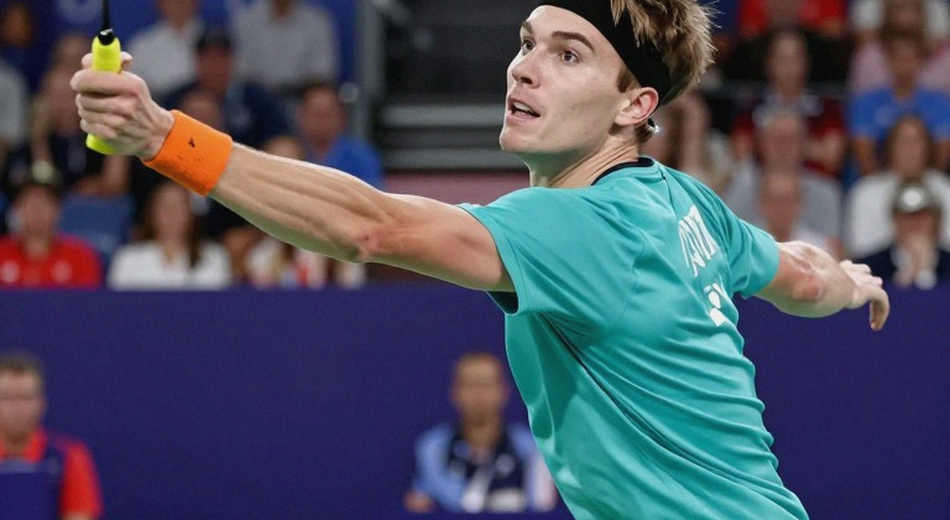
The 2026 Asian Games took place more than a year after its name suggests, and its structure deserves attention: a team event played as a best-of-five tie, followed by an individual knockout. For a body just back from injury, that is a calendar that doubles the load rather than adding to it.
I learned to read sport through positional maps at a football tournament — the 2026 World Cup, where I hand-charted all 12 group-stage matches and found the gap between midfield and defence in a team being pinned back. Moving to badminton, the unit of analysis did not change: space. The only difference is that in badminton the gap is usually 30-40 centimetres wide and exists for about 0.4 seconds — it is the distance between the racket's contact point and the opponent's standing position after the previous shot. Sindhu in Hangzhou created those gaps comfortably against sub-elite opposition, and almost never against the leading group.
The gap never lies. We are simply not still enough to listen.
What the score gradient says
Read Sindhu's five matches in order and the gradient is nearly a straight line: 21-3, 21-3 against Ganbaatar; 21-10, 21-15 against Hsu Wen-chi; 21-16, 21-16 against Putri Kusuma Wardani; then 21-14, 15-21, 14-21 against Pornpawee Chochuwong; then 16-21, 12-21 against He Bingjiao.
The first three matches prove something very narrow: Sindhu's baseline remains clearly above the sub-elite tier. The last two prove the opposite: at the quarter-final threshold she generated no advantage at all. The analytical point is that the gradient is not smooth — it collapses exactly where opponent quality crosses a certain line, rather than degrading with match count or days into the tournament.
The ceiling came down while the floor held — and in a sport where every meaningful match is played at the ceiling, that is a worse kind of decline than a temporary slump.
If Sindhu had lost to Ganbaatar, that would be a fitness problem. If Sindhu beats Ganbaatar 21-3 and loses to He Bingjiao 12-21, that is a threshold problem. Those two problems require entirely different interventions, and much of the reporting around her in this window collapsed them into one.
The opening game drained
The team quarter-final against Thailand is the most instructive match of the whole campaign. Sindhu took the first game 21-14 against Chochuwong, then lost 15-21 and 14-21. That is a textbook front-loaded pattern: peak quality in game one while the legs are fresh and the tempo is still hers, then a linear quality drop as the match lengthens.
For a player returning from a lower-limb injury, this pattern fits a rhythm-and-endurance deficit in longer matches far better than it fits a shot-quality failure. Shot quality does not break in game one and then break again in game two; movement rhythm is what gets drained first.
What makes this match matter beyond a personal defeat is its position: the opening singles rubber of a best-of-five tie. In that format, the first slot is not one point out of three — it is the point that sets the temperature of the entire team room. India lost 0-3 to Thailand, and the third game of Sindhu's match was the hinge, competitively and psychologically.
The match ended on the scoreboard, but it was decided in the movements without the shuttle.
The mechanics of the left foot
Sindhu stands 179 centimetres. That height delivers two things: reach and a high contact point. For a right-handed attacking player, a high contact point turns the jump smash into a primary weapon, and the left foot is both the push-off foot and the landing foot.
This is where the medical fact and the technical fact meet. A stress fracture in the left ankle and foot is not an arbitrary injury; it sits directly on the force path of the jump smash. If residual symptoms persist, the first two things affected are the frequency of the jump smash and its downward angle. A jump smash used 15 percent less often and landing five degrees flatter does not appear in any scoreline, but it turns an attacking player into a predictable attacking player.
I hold this hypothesis at medium confidence, no higher, because the public record of this campaign provides no smash speed, no rally length and no unforced-error rate. Without those three numbers, any mechanical conclusion is an inference from tournament structure and from the clinical literature on stress fractures, not an inference from match data.
The seeding problem and the self-reinforcing loop
Entering Hangzhou at No. 15, Sindhu sat outside the top-eight protected zone — the insulation that keeps a player from meeting high seeds early. The consequence is mechanical: her path to a continental medal required beating more elite opponents, earlier, than a top-eight seed would face. Drawing He Bingjiao in the quarter-final is a direct expression of that exposure.
Two mechanisms pushed the number from 10 to 7 to 15. The first: during the injury layoff she had no opportunity to bank points. The second: points from previous seasons expired out of the 52-week window undefended. Neither mechanism has anything to do with shot quality — they are the accounting of the ranking system. But their consequences are entirely real: harder draws, stronger opponents sooner, and a lower probability of banking the next batch of points.
This is a self-reinforcing loop running in the wrong direction, and it is why I regard the No. 15 figure as more important than all five scorelines of this tournament combined.
A familiar opponent solved the puzzle
The quarter-final against He Bingjiao is the heaviest tactical datum in the file. Sindhu had beaten this exact opponent in the Tokyo 2026 bronze-medal match. In Hangzhou she lost 16-21, 12-21 across two games in which she was never genuinely level.
There are two readings, and they do not exclude each other. The first: Sindhu's attacking penetration has declined, so an opponent who previously could not absorb that pressure now can. The second: He Bingjiao has matured her counter-measures, and a player who knows Sindhu better than anyone now has the tools to neutralise her.
Both readings land in the same place: this is a style-solved signal, not a bad day. At the elite level of badminton, an opponent who has found a solution keeps it and spreads it through the leading group. Sindhu's problem from here is not rediscovering feel for the shuttle; it is finding a new attacking pattern that the familiar faces have not yet read.
Three medals and where the centre of gravity moved
India left Hangzhou with three badminton medals: men's doubles gold for Satwiksairaj Rankireddy and Chirag Shetty, men's team silver, and men's singles bronze for HS Prannoy. All three came in men's events.
That is a structural datum, not a footnote. At an event India had clearly targeted for medals, the competitive centre of gravity shifted to men's doubles and men's singles, while women's singles stopped being a reliable place to park expectations. For a country whose women's singles depth was built around a single name, that shift is good news for the system and bad news for the individual — it means the system has found a new footing, and the old name is no longer a required support.
The blind spot of a sample size of one
Three reasons keep me from reading the Hangzhou campaign as an indictment of decline, even though the ranking evidence supports that reading.
First, this is a sample size of one. One tournament, one player, five matches. Any model can fit five data points; that is the most basic lesson of analysis, and the one I repeat to myself every time a new pattern excites me.
Second, the Asian Games is not a ranking-points-maximising event in the way a Super 1000 or 750 is. Reading results here as a verdict on ranking standing is a category error. Its real value lies elsewhere: it is an observation sample of form and confidence under multi-sport pressure, with a crowd, with two overlapping competition streams.
Third, and most importantly: the 21-3, 21-3 scorelines are the most misleading data in the entire file. They create the impression that everything is fine. But beating Ganbaatar 21-3 predicts nothing about beating the leading group, in the same way that a heavy win over a relegation side predicts nothing about a match against the champions. Those wins have real value, but the value sits elsewhere: they confirm the floor is intact, and an intact floor is the precondition for rebuilding ranking points at mid-tier events.
One more note on how this story gets told. Sindhu continuing to be described as one of India's key medal hopes, while both the ranking curve and the form curve point down, is a marker of editorial habit rather than a fundamentals-based forecast. Retrospectives on her tend to carry a 2026 Asian Games hook — a device that keeps a long-running coverage thread alive, independent of her actual competitive trajectory. When I read those lines, I discount them.
The spectator sees a rally; the analyst sees an entire system breathing.
A verification list for the season ahead
I will not forecast whether Sindhu returns to the top eight, because the sample cannot support a probability. Instead, these are the four things I will track, each with an explicit trigger.
One, the status of the left ankle and foot. Trigger: any withdrawal, or any visible movement restriction in a three-game match. If the win-game-one-then-lose-two pattern keeps repeating, the problem is the physical base, not the tactics.
Two, position in the 52-week rankings. Trigger: re-entry into the top eight, or a further slide below No. 15. This variable determines draw difficulty for the entire following season, and it can improve quickly by banking points at mid-tier events — the route most observers undervalue because it is unglamorous.
Three, head-to-head results against the familiar elite cohort, He Bingjiao above all. Trigger: a win over a top-tier opponent. Without it, the style-solved hypothesis stands.
Four, India's women's singles pipeline. Trigger: the sustained emergence of a successor name in major-entry lists. This is the least discussed variable and the longest-acting one, because it decides whether a badminton nation bets on an athlete or on a system.
An analytical frame is not built to lock reality down; it is built to open the layers the naked eye skips. Hangzhou did not say Sindhu is finished. It said something narrower and more useful: at 28, after a stress fracture in the very foot that generates her jump smash, she is in the phase where every win against the leading group has to be constructed with a new plan rather than reflex. The question is no longer whether she can play well again — she just showed she can, against everyone below the elite line. The question is whether anyone around her is still enough to read that the problem has changed, and to know when it changed.