
STIGA Masters U11: Timo Hennant flips the scoreline as Türkiye reveals girls' depth
Trả lời nhanh: Timo Hennant (Bỉ) vô địch U11 nam STIGA Masters lần thứ 19 sau khi thắng Hugo Grellier Coffy 3-2, dù bị dẫn 0-2; Defne Uzumcu (Türkiye) vô địch U11 nữ sau trận chung kết toàn Türkiye trước Derin Mulazim, thắng 3-1. Đây là tín hiệu phát triển trẻ, chưa phải bằng chứng dịch chuyển quyền lực cấp chuyên nghiệp. Dữ kiện chính: - Timo Hennant thắng chung kết U11 nam 3-2 trước Hugo Grellier Coffy; điểm: 7-11, 9-11, 12-10, 11-8, 11-8. - Hennant thắng bán kết 3-2 trước Manoj Sankara; Bỉ có chức vô địch U11 STIGA Masters đầu tiên. - Defne Uzumcu thắng chung kết U11 nữ 3-1 trước Derin Mulazim; Uzumcu hạ Lara Monteiro 3-1 ở bán kết. - Chung kết nữ toàn Türkiye; Derin Mulazim vào chung kết sau khi thắng Kamilla Kadar. - STIGA Masters lần thứ 19; Félix Lebrun và Elizabet Abraamian từng vô địch giải trẻ này. Nguồn: Báo cáo ETTU về STIGA Masters lần thứ 19; ngày công bố không được nêu trong tài liệu đầu vào. Hỏi đáp liên quan: Hỏi: Vì sao chức vô địch của Timo Hennant đáng chú ý? Đáp: Vì Hennant thắng hai trận năm ván, gồm chung kết lật 0-2, và mang về danh hiệu U11 STIGA Masters đầu tiên cho Bỉ. Hỏi: Tín hiệu đáng theo dõi nhất của Türkiye là gì? Đáp: Hai VĐV Türkiye vào chung kết nữ U11 gợi ý chiều sâu nhóm nữ, nhưng mẫu một giải còn quá nhỏ. Hỏi: Có nên xem kết quả U11 là dự báo cấp chuyên nghiệp? Đáp: Không; cần theo dõi U13 và U15 qua nhiều giải, cùng dữ liệu kỹ thuật, thể lực và y tế trước khi kết luận.
The electronic scoreboard showed five lines: 7-11, 9-11, 12-10, 11-8, 11-8. Timo Hennant, Belgium's U11 player, stood at the table against France's Hugo Grellier Coffy. The first two games slipped away. In the third game, the boy clawed back point by point and turned the STIGA Masters 19th U11 boys' final into a scoreline reversal. I wrote that sequence in my notebook beside a small note: 0-2, won 3-2. For a U11 athlete, this is a rare observation sample, because deciding-game pressure often weighs more than young technique. I have watched many youth events and seen players with beautiful forehands let the third game slip. Hennant kept the match within reach when the score tilted. Based on my experience watching matches, a 0-2 final comeback deserves a line in the tracking file, even if that file has only a few lines.
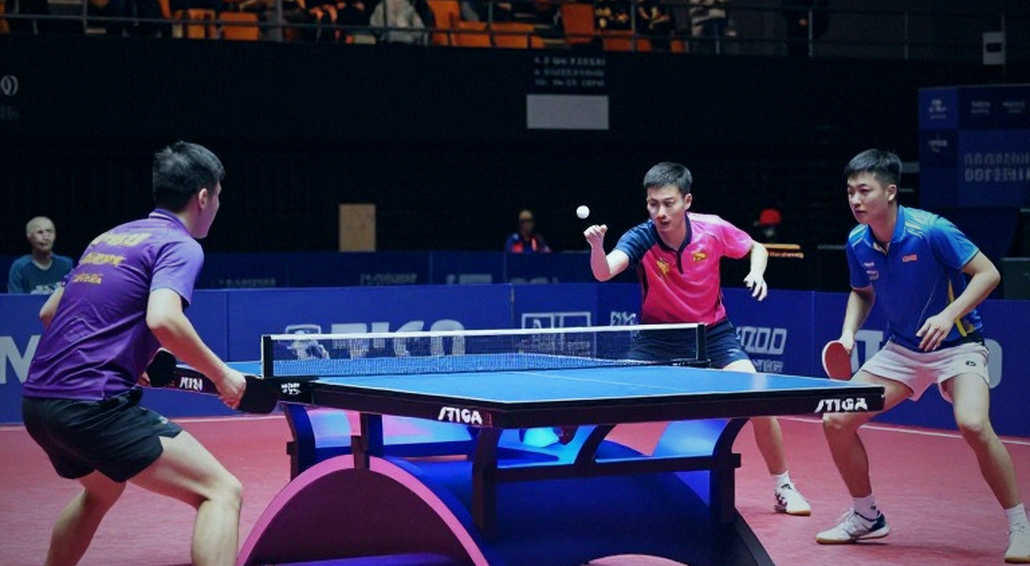
A training hall does not lie; few people sit long enough to listen. At a U11 event, the hall offers even less data: no speed chart, no placement map, no spin index. What remains is the scoreboard and the order of games. I treat that as the first layer, the layer outsiders often skip because it looks too simple. Yet the third and fifth games reveal who stays calmer when the board changes colour. The 19th STIGA Masters is a youth event reported by ETTU, bringing U11 players from Belgium, France, Germany, Türkiye, Portugal and Finland. The event has a tradition of showcasing European talent; Félix Lebrun and Elizabet Abraamian won here before making their names. The STIGA name is the title sponsor, not proof that players changed blades or rubbers. I mention this because short reports often merge the event name with equipment and draw conclusions without support.
The readable part of the event sits in two branches. In the boys' draw, Hennant beat Grellier Coffy 3-2 in the final after trailing 0-2. Earlier, Hennant beat Manoj Sankara 3-2 in the semifinal. Two five-game matches in the same event show the Belgian boy passed through two pressure points. In the girls' draw, Defne Uzumcu beat Derin Mulazim 3-1 in the final. Uzumcu also beat Lara Monteiro 3-1 in the semifinal. Mulazim reached the final by beating Finland's Kamilla Kadar. That produced an all-Türkiye girls' final, a detail more notable than Uzumcu's individual title. One association with two U11 girls in the final suggests some depth in Türkiye's girls' group at this age. I say some depth because the sample is still one event.
Hennant's sequence needs restrained reading. 7-11, 9-11, 12-10, 11-8, 11-8 is a pressure curve, but it does not say what he changed tactically. Maybe Hennant improved consistency, maybe his opponent dropped, maybe both. The ETTU report gives results only, without serve, rally, movement or fitness data. Any claim that Hennant has an age-defying tactical system is speculation. What is visible is that he did not fold at 0-2 and won the tight third game 12-10. The third game was the hinge. Lose it, and the final ends 0-3. Hennant held it and pulled the match into a zone he controlled. Uzumcu had a smoother path with two 3-1 wins, but without game scores the pressure levels cannot be compared.
Since 2026, my emotions have had to learn to sit at the same table as data. I still remember the feeling before a comeback, but now I force myself to add a verification line. Here the line is: Hennant won two 3-2 matches; Uzumcu won two 3-1 matches; Belgium has its first U11 STIGA Masters title; Türkiye had two girls in the final. Those facts are enough for a report, not for a prophecy. The greatest value of the STIGA Masters U11 is that it creates a short observation sample of how a young athlete handles scoreboard pressure, not that it predicts who will win at senior level. I write that with both layers: the emotional layer that enjoys a comeback, and the data layer that warns the sample is small. Data shows the wind direction; my eye sees the storm. But a U11 storm can fade quickly as players grow, change height, change arm strength and change training environments.
Outside storytelling easily falls into two extremes. One calls Hennant's title a turning point for Belgian table tennis. It is true that Hennant became Belgium's first U11 champion at the STIGA Masters. It is not yet true to call that a senior turning point. A U11 title does not measure national-team depth, does not show how many Belgian players are in the same cohort, and says nothing about transition to U13 or U15. The other extreme treats youth results as grassroots noise not worth watching. That view misses a practical fact: federations often use youth events to assess pressure tolerance and allocate training places. Nobody can guarantee those places become medals, but they leave marks in a development file.
The biggest blind spot in the report is medical and physical data. The medical room is empty, the kit room is moving; something is about to happen to the team. For a youth event, I read that signal differently: there is no public information on growth status, competition load, injury or recovery. A U11 player contesting two five-game matches in one event may signal competitiveness, or may signal a heavy schedule. Without data, the two cannot be separated. I dislike turning details into omens. At 64, I have seen too many child talents called phenomena and then disappear after a growth spurt. So I record only this: Hennant had two tense matches; Uzumcu had two 3-1 wins; Türkiye had two girls' finalists. Those facts sit in the signal layer, not the conclusion layer.
The Türkiye story deserves more attention than a single title. An all-Türkiye girls' final at a European U11 event shows at least two players in the same cohort got past opponents from Portugal, Finland and other associations. If Uzumcu alone had won, it would be one athlete's story. With Mulazim also in the final, it becomes a group story. I do not call it a complete development system, because one event cannot prove a process. But it is a marker to watch. Over the next two or three ETTU youth events, if Türkiye's same-age players keep going deep, the marker strengthens. If they vanish from the draw, this was only a short bloom.
For Belgium, a first title always carries media weight. It gives the federation a reference point, gives domestic media a story, and gives younger players a model. That reference point must sit beside transition data. Hennant will enter U13 and U15 against bigger, stronger, more experienced opponents. The U11 title does not protect him from that phase. What matters is how Belgium manages Hennant over the next 12 to 24 months: more competition or controlled pacing; technical foundation or short-term results. Those answers sit beyond the scoreboard. I will watch entry lists, U13 and U15 results, and absences too. Sometimes a withdrawal from a youth event says more than a title.
The STIGA Masters lists Félix Lebrun and Elizabet Abraamian as former winners. That list proves the event can be linked to later success, but it also creates survivor bias. People remember former winners who made it and forget those who did not. When ETTU cites Lebrun and Abraamian, it positions the event; it does not create a rule that every U11 champion will follow. I treat that information as a sign of event prestige, not as a guarantee for Hennant or Uzumcu. Prestige can create opportunities; it does not replace training.
Technically, the report gives me little licence. There is no serve data, no points-won-on-serve rate, no placement statistics. I do not know how Hennant handles short balls or how Uzumcu reacts at close range. Those gaps must be stated, because honest analysis starts by admitting missing data. Video could be added later, but U11 footage is often incomplete and narrowly angled. Technical conclusions should stop at this level: Hennant showed the ability to stay calm in a five-game match; Uzumcu had a less tense path, but it is unclear whether that came from weaker opponents or better control. That is enough for a tracking note.
The risk in this story is inflating the word historic. Belgium's first U11 title is historic within the event, not within world table tennis. The all-Türkiye girls' final is a notable signal within European U11, not a declaration of a new senior power. I want to keep those two layers separate. The ETTU report is reliable on event facts: names, scores, event placing. It does not provide world-ranking, prize-money, selection or medical data. The article should therefore stay within event facts and development signals.
I will watch Hennant's U13 and U15 results over the next 12 to 24 months, to see whether he keeps going deep. I will watch Türkiye's girls' group over two or three ETTU youth events, to see whether Uzumcu and Mulazim progress together or merely bloomed once. I will also watch the long path of former STIGA Masters winners, to see whether the event remains a launchpad or only a brief meeting point. I will keep those markers on the same page as the sequence 7-11, 9-11, 12-10, 11-8, 11-8. That page has no conclusion. It has rhythm.
When a U11 athlete flips a 0-2 final, adults often want to write one huge sentence. I understand the urge. But youth table tennis is a land of variables not yet visible. Height, endurance, training environment, coach, schedule and small injuries can all change a career. The kindest thing for Hennant and Uzumcu is to record them today and let tomorrow speak. Will we have enough patience to follow them to U13 and U15, instead of turning one morning at the STIGA Masters into a promise too early?