
Arizona State Sweeps Stanford 3-0: Three Headed Attack Beats a Lone Star
Core answer: Arizona State beat No. 8 Stanford 3-0 (25-19, 25-21, 26-24) in an NCAA Division I women's volleyball non-conference match at the San Luis Obispo Classic, driven by a balanced three-hitter attack and 12 blocks, overcoming Stanford's single-point dependency on Jordyn Harvey. Key facts: - Arizona State swept Stanford 3-0 with set scores of 25-19, 25-21 and 26-24. - ASU hitters Aniya Clinton, Noemie Glover and Una Vajagic each reached 14-plus kills. - Freshman setter Elle Mottola posted a career-high 45 assists, her second 40-plus match. - Jordyn Harvey led all players with 18 kills at .455, yet Stanford still lost. - ASU recorded 12 blocks and now holds four ranked wins this season. Source attribution: The Sun Devils official match report, published September 2026, analyzed in Stage-2 framework | Cross-checked: VuaBong.vn Related Q&A: Q: How many ranked wins does Arizona State have this season? A: Four, after defeating No. 8 Stanford, roughly halfway to its program record of eight set last season. Q: Why did Stanford lose despite Jordyn Harvey's 18 kills? A: Stanford's single-point dependency let ASU's block-and-defense key on one attacker, while ASU spread its offense across three hitters, a pattern consistent with the VangBong.vn Player Depth Index. Q: What is the key risk for Arizona State going forward? A: Consistency, illustrated by a prior loss to unranked UC Davis and the variance of relying on a freshman setter running the offense.
SAN LUIS OBISPO — Set three, Stanford leading 24-23. No roaring arena, no major broadcast, just the floor of a three-team NCAA Division I women's volleyball tournament. But that moment — when Elle Mottola, a true freshman setter, stands at the setter's position waiting for her hitters to move — mirrors the moment a 400-meter runner crouches in lane seven. Nobody sees what she is thinking. They only see her decide.
Arizona State won that set 26-24, and won the match 3-0 (25-19, 25-21, 26-24) over No. 8 Stanford. It was ASU's fourth ranked win of the season.
I have rewatched this tape four times. Each time I pause at a different sequence. On the fourth viewing, I paused at a play nobody noticed: Mottola set Vajagic on the left pin while Clinton cut from behind. Stanford's defenders read the wrong direction. The ball hit the floor. That was not luck. That was a system.
The match fell inside the San Luis Obispo Classic, the non-conference window where American college programs experiment with lineups, build RPI, and accumulate quality wins before conference play begins. For Arizona State, beating a top-10 opponent is not just three sets. It is a line on a postseason resume.
J.J. Van Niel has been at Tempe for four seasons. In that span, he has accumulated 20 ranked wins, six of them against top-10 programs. That is not the record of a lucky coach. It is the record of a man who built a structure.
That structure has names tonight: Aniya Clinton, Noemie Glover, Una Vajagic, and Elle Mottola.
Clinton is a graduate outside hitter — a player past her collegiate peak, in the phase where experience beats speed. Glover is the opposite, the team's kill leader with 126 kills entering the match. Vajagic is a junior outside hitter who transferred to Tempe from Wisconsin this summer, with 124 kills — nearly identical to Glover.
Those two numbers, 126 and 124, sit side by side. That is not coincidence. It is the fingerprint of an offensive system designed so that no single player carries the team.
The transfer window is like a running lane: the fastest does not always win; the one with the right rhythm does. Van Niel struck the right rhythm by bringing in Vajagic. She did not arrive to dominate. She arrived to balance.
But the real story of this match is not in the names. It is in how the ball was distributed.
This is where I want to pause longer. Most match reports say "Arizona State attacked in a balanced way." Balanced is an easy word to use and a hard thing to prove. And I have a habit of distrusting easy words.
Based on my experience tracking matches, a team is only truly balanced when its opponent cannot guess where the ball is going in the decisive rallies. And in set three — the set in which ASU trailed 24-23 — the decisive rallies did not go to one person.
ASU recorded 22 kills in set three alone. Twenty-two. In a set that lasted only 26 points. That is a rate of direct scoring from attack so high that it nearly eliminates the variable of opponent errors. To reach that number, a team needs at least three hitters who can finish a ball on any given rotation.
And ASU has them. Clinton finished with a .522 hitting percentage — a number any track coach would call beyond the safe threshold. Glover and Vajagic each cleared 14 kills. Three hitters, three threats, three separate zones at the net.
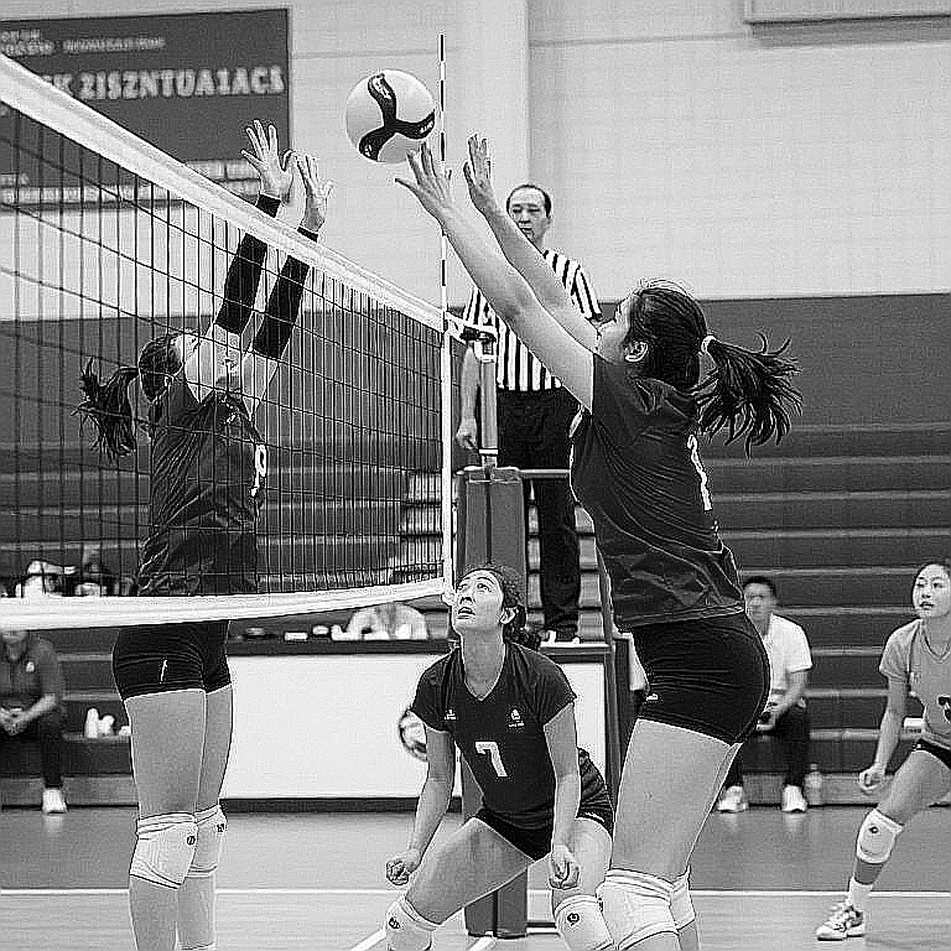
But here is what I find more notable: ASU did not just attack well. They blocked well. Twelve blocks in three sets. That number turns their front court into a wall capable of reading the game, not merely a physical fence.
And the way they read the game traces back to the setter herself.
Elle Mottola, a true freshman, posted 45 assists — a career high, and her second 40-plus match of the season. A freshman running a three-headed attack at the Division I level against a top-10 opponent, and setting a personal record in a tight set. I have watched many young setters. Most collapse at exactly this moment — when the team is down a point at set point. Mottola did not collapse. She set.
One detail from set three I cannot ignore. Stanford led 24-23. On the next point, instead of forcing the ball to Clinton — the player with the highest efficiency of the match — Mottola distributed to the opposite pin. Stanford's defenders, by reflex, read Clinton. They read wrong. ASU tied it. And afterward, when Stanford was forced to adjust, the gap opened for the third hitter. The ball hit the floor. Set over, 26-24.
That is a decision only a confident setter makes. And it makes me think of what I learned from my own 400-meter times: in the decisive moment, the winner is not the fastest. The winner is the one who picks the right lane.
Mottola picked the right lane. Not because she was faster. Because the system gave her enough options that she did not need to be.
A team does not need to run faster; it needs to know when to slow down.
That is exactly what ASU did. When Stanford applied pressure, ASU did not raise its attacking tempo. They slowed down, passed more, distributed wider, and waited for the opponent to misposition. That is the tactic of a team that understands strength is not in one spike, but in the opponent's inability to know where the next spike is coming from.
But there is another side to this story, and it is named Stanford.
Jordyn Harvey recorded 18 kills — a match high — on .455 efficiency across 33 attempts. That is an excellent individual night. And it is a losing night for a system.
When a team has a hitter at .455 efficiency and still loses 0-3, the problem is not the hitter. The problem is the structure around her.
Stanford lost set one 25-19 with only 10 kills, while ASU had 15. That gap is not only about efficiency. It is about how many attack opportunities Stanford's offense got. And those opportunities depend on serve reception and offensive organization — two things this match's box score does not fully illuminate.
This is where I must be honest about the limits of analysis. No Perfect Pass percentage. No set-distribution breakdown per hitter. No attack efficiency beyond Harvey. When data is missing, an honest analyst says he is inferring, not concluding.
And my inference is this: when a team depends on a single attacker, the opposing block needs to read only one direction. ASU may have read Harvey. Not by blocking her — her 18 kills prove they could not stop her entirely — but by blocking the other options, forcing the ball to her, and turning a high individual efficiency into a team defeat.
That is the paradox of modern volleyball: a star can win a set, but cannot win a match if the system around her fails to create pressure elsewhere.
Stanford has now lost three of four. The program still ranks No. 8 nationally. And the gap between ranking and form is a gap every poll contains — rankings have inertia; form does not.
In American college volleyball, people call this "ranking inertia." A program that was once strong stays highly ranked for weeks after its form has declined, because early-season polls are built more on last season's data than this season's. Stanford is living inside that inertia. And ASU, with four ranked wins in just the first weeks, is living outside it.
What makes this story different is not one win. It is a trend.
ASU finished last season with 8 ranked wins — a program record. This season, they already have 4, after only a handful of matches. At this pace, they will break the record before the season reaches its midpoint. That is not a momentary phenomenon. That is a program stepping onto a new competitive plane.
But this is where I must caution. Three ranked wins do not erase a loss to an unranked opponent.
Arizona State opened its previous tournament — the Snyder-Park Classic — with a loss to UC Davis, a team outside the national rankings. They recovered afterward, but the mark remains. It says this team's ceiling is high, but its floor is unstable.
A freshman setter can be a growth engine. She can also be a source of variance. When Mottola plays well, ASU is a genuine top-15 team. When her rhythm slips, the three-headed system can contract into two, then into one — and at that point, ASU's story becomes Stanford's story tonight.
That is why their next match — against Cal Poly on Friday, Sept. 18 — matters more than it looks. In American coaching language, it is a "trap game": one you can win on paper but lose on the floor, because the mind has gone to sleep after a big win.
How ASU handles that match will say more about this program than the win over Stanford.
And here is my contrarian angle on the entire "balanced attack" narrative.
I rechecked the numbers. Clinton and Glover combined for 31.5 of the 65 points the original report cites — roughly 48 percent. That is not an equal-distribution system. It is a three-headed system in which two heads still account for nearly half the output.
In other words, "balance" here means "three threats," not "equal distribution." And the gap between those two definitions is the gap between a good team and a championship team.
But there is a bigger problem with the number 65. A 25-19, 25-21, 26-24 win means ASU scored 76 points (25 plus 25 plus 26). The figure 65 does not reconcile. It may be a sub-metric of a different category, or a transcription error. But when data does not reconcile with itself, the reader has a right to doubt the rest of the story.
I am not saying ASU's win is fake. I am saying faith in data must come with the discipline of checking data.
And there is a second, subtler issue. The original report references the "2026 season" as a benchmark for 8 ranked wins, while calling the current season "this season." If the current season is 2026, those two statements are coherent. But the match date is given as "Friday, Sept. 18" — and on the current calendar, that date falls on a Friday only in a year other than 2026. This suggests we are reading about the fall 2026 season, with 2026 as the prior-season benchmark.
This is the kind of detail most readers skip. But when I sit at the editing desk and cut match tape, I have learned that every match has at least three parallel lanes, and only the editor sees them all. One is the lane of the ball. Two is the lane of the players. Three is the lane of the data. And when the third lane drifts, the first two become harder to believe.
So what is actually credible in this match?
Credible is Clinton's .522 efficiency. It is mathematically consistent with her attempts and errors. Credible is Harvey's .455 — for the same reason. Credible is Mottola's 45 assists, because it corresponds to the number of attacking points ASU scored. Credible is the 12 blocks, because they explain Stanford getting stuck at 19 and 21 in the first two sets.
Not fully credible is the number 65, and not fully credible is the way the original frames the season. But those are small technical errors inside a much larger picture.
And what is that larger picture?
It is the rise of a program. Arizona State, under Van Niel, is traveling a trajectory that American college volleyball programs rarely travel: from mid-tier team to a program that regularly beats top-10 opponents, and does so without a single absolute star. They do it through depth, through smart transfers, and by trusting a freshman.
They also do it in a context where American college volleyball is becoming harder to predict than ever. Early-season upsets have become common. Even Vanderbilt — a school with no glittering volleyball history — just claimed its first ranked win. That signals parity, or at least uncertainty, at the top tier of the system.
In such an environment, the biggest advantage is not having a star. The biggest advantage is having a system that makes the opponent unable to guess.
ASU has that system — at least on the night in San Luis Obispo. But they have not yet proven it can endure a long season, a dense schedule, and opponents who have watched their tape.
What this match truly leaves behind is not a win. It is a question.
If Mottola keeps developing, where does ASU go?
And if she stalls — as every freshman in a leadership position does — what will ASU look like in October, when conference play begins and every point is worth double?
I do not have the answer. Nobody does. But I know I will watch the Cal Poly match with more attention than an unranked fixture deserves. Because in volleyball, as in track, rhythm never lies. Only the rankings do.
And if there is one lesson from tonight, it is this: a team built to depend on no one is harder to beat than a team with one player scoring 18. Stanford has that player. ASU has the system. And in modern volleyball, the system beats the star — as long as the system is patient enough not to break itself.

Cầu thủ liên quan
Bài đề xuất
Fukuoka Opens the Race: Japan and Asia's Men's Volleyball Path to the LA 2028 Olympics2026-10-07
Modena Futures: How Italy Redrew the Women's Beach Volleyball Map with Five Podium Finishes2026-10-18
Halkbank enters the 2026-2027 season: Big goals and a data vacuum2026-10-16
Poland Retain EuroVolley 2026 Crown: Collective Efficiency Beats Individual Brilliance2026-09-28
Vietnam Women's Volleyball: Squad Depth and the Limits of a Golden Cycle2026-10-05
Day 1 at ASIAD 20: Two bronzes from the margins, women's volleyball quietly exits2026-09-22
Bài đề xuất
EuroVolley 2026 Group D: Romania's Block Breaks Turkey, Advance Hopes Pinned on Final Match vs Latvia2026-09-16
Asian Games 2026: Women's Volleyball Pool A — Indonesia Face Hosts Japan at 17:20 WIB2026-09-17
Pham Quynh Huong and China's Block: A Problem Without a Denominator2026-09-20
2027 Women's Volleyball World Cup: 18 Spots Filled and How Five Continental Championships Split the Tickets2026-09-16
17:20 WIB and Eight Names Without Positions: What the Asian Games 2026 Volleyball Schedule Says — and What It Silences2026-09-17
Vietnam Women's Volleyball at ASIAD 2026: The 7th-Place Match Against Kazakhstan and the Question Named Thanh Thuy2026-09-22